


- Building Acoustics
- Industrial Noise
- Vibration in Buildings
- Vibration in Pipework
- Planning, Permitting & Sustainability
- Pulsation Analysis
- Surge Analysis
- Measurement & Testing
- Services to Consultants
Regenerating the Palace (Prince of Wales) Cinema, Kentish Town
17 February 2026 by Elise Phoenix
Introduction
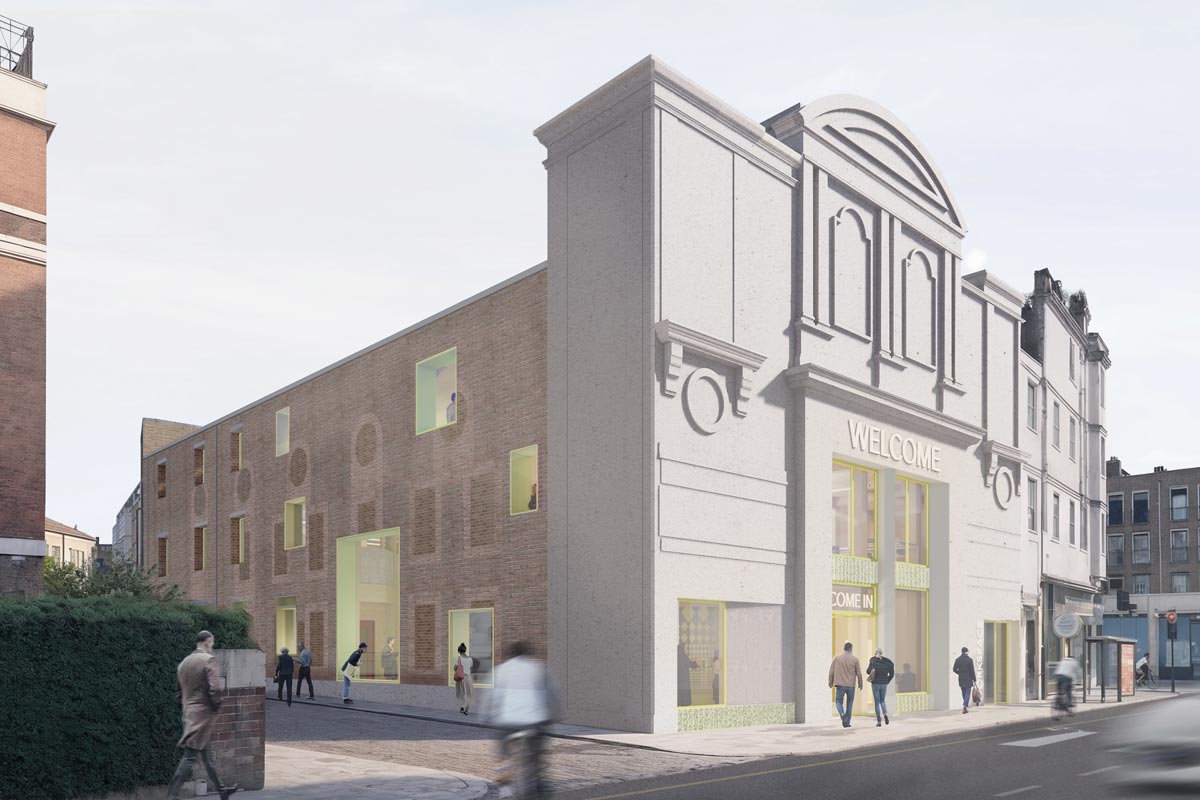
The former Palace Cinema on Prince of Wales Road in Kentish Town is a well-known local landmark. Originally constructed in 1913, the building has been part of the area’s cultural life for over a century, but in recent decades it has been underused and increasingly disconnected from the local community.
London Borough of Camden has been leading proposals to bring the building back into active public use. Their plans are to transform it into a practical Neighbourhood Space that will include meeting rooms, collaboration zones, work spaces and an event area.
The project forms part of Camden’s commitment to a green transition, with retrofit and material reuse prioritised over demolition. Architects IF_DO are leading the retrofit design, working alongside Webb Yates Engineers, David Miles & Partners (MEP), and Spectrum Acoustic Consultants.
Although the cinema is not classed as a listed building, it is recognised as an important local heritage asset. As a result, the regeneration needed to be sensitive to the building’s historic character while also meeting modern expectations for comfort and flexibility.
Indeed, acoustics and noise vibrations were a critical part of that balance. Mixed-use community buildings often fail not because of lack of ambition, but because noise, privacy and room acoustic issues are not resolved early enough. Spectrum Acoustic Consultants were appointed to help ensure the project could secure planning consent, and then to support and influence the design in RIBA Stages 3 and 4 to ensure it functions effectively once in use.
The challenge
From an acoustic perspective, the project presented several interconnected challenges.
First, the proposed change to a multiple functioning building introduced competing and sometimes conflicting acoustic requirements. Quiet meeting rooms and workspaces need low background noise levels and good speech privacy, while collaboration zones and event spaces must support speech clarity without creating disturbance elsewhere in the building.
These conditions are difficult to achieve within a historic cinema structure that was never designed for multiple uses or modern acoustic separation.
The second challenge is noise from mechanical services had to be carefully controlled. Introducing new plant into a constrained urban site, surrounded by residential dwellings, required robust assessment to satisfy planning officers and Environmental Health. Any failure here would have placed the planning application at risk.
Third, the building’s heritage status influenced how acoustic solutions could be implemented. While the site does not carry statutory listing, its local landmark status meant that wholesale alteration of façades, rooflines or visible elements would be heavily scrutinised. Acoustic mitigation therefore needed to be effective, discreet and proportionate to the original building.
Finally, sustainability was a central driver for the project. London Borough of Camden’s ambition was not simply to reuse the building, but to do so responsibly, minimising unnecessary demolition, retaining existing fabric where possible, and making careful material choices. From an acoustic perspective, this required a more nuanced approach than simply adding mass or layers everywhere.
Our role
Spectrum Acoustic Consultants were appointed from RIBA Stage 3 to support the planning application and to help shape a viable acoustic strategy for the building’s future use.
A key part of our role was advising on mechanical plant noise in support of planning. We undertook a detailed assessment of proposed plant noise in accordance with BS 4142:2014+A1:2019, establishing clear and defensible noise limits that reflected the surrounding context and local authority expectations. This work provided confidence to the design team and planning officers that new services could be introduced without unacceptable impact on nearby residents.
The team at Spectrum advised on acoustic privacy internally, including noise control between spaces. Using criteria in BS 8233:2014 for internal ambient noise levels, we worked with the architect and wider design team to define realistic performance targets for meeting rooms, workspaces and shared areas. This involved floor specifications to achieve appropriate levels of acoustic separation, taking account of the building’s existing structure and the need to minimise intrusive works.
We also advised on room acoustics. Spaces intended for meetings, collaboration and events require controlled reverberation to support speech intelligibility and comfortable use. In a former cinema, with large volumes and hard surfaces, this needed to be addressed carefully and proportionately. Our team here at Spectrum advised on absorption strategies and finishes that could be coordinated with the wider design team.
Throughout the project, sustainability and reuse of existing materials were key priorities. Instead of automatically adding new layers or heavy constructions, we worked with the design team to keep as much of the original building as possible. We then carefully selected materials and finishes to achieve the required acoustic performance without unnecessary additional construction.
Spectrum Acoustic Consults played an important role in coordinating the acoustic design with the wider project team. Acoustic performance affects the architecture, structure and building services, so we worked closely with all consultants to make sure the acoustic requirements were clearly understood and carried through as the design progressed.
The wider project team included:
Client: London Borough of Camden
Employer’s Agent: Ikon Consultancy
Quantity Surveyor: Alban LLP
Architect: IF_DO
Structural and Civil Engineer: Webb Yates Engineers
MEP Engineer: David Miles & Partners
Acoustic Consultant: Spectrum Acoustic Consultants
CDM Advisor: Baily Garner
Sustainability Consultant: Webb Yates Engineers
Fire Engineer: Cahill Design Consultants
Party Wall Surveyor: GIA Surveyors
Outcome
Spectrum’s early involvement helped de-risk the planning process and enabled London Borough of Camden to secure planning consent for the Neighbourhood Space with confidence that noise matters had been properly addressed.
The environmental noise assessment and plant noise strategy provided clear and defensible technical evidence required by the local planning authority, helping the project to avoid delays or any conditions that might have affected the future of the building.
Internally, the acoustic strategy demonstrated how a historic cinema could be adapted into a flexible neighbourhood facility without compromising usability. Issues of privacy, speech clarity and noise control were considered at a stage where they could be integrated into the design, rather than retrofitted later at higher cost or with greater visual impact.
The project demonstrates that acoustic performance and sustainability objectives are compatible when addressed early and collaboratively. By working closely with IF_DO, Webb Yates Engineers and David Miles & Partners, Spectrum has helped deliver an acoustic strategy that supports retrofit over rebuild and respects the heritage character of the building.
The Palace Cinema is on track to reopen as a completed Neighbourhood Space in 2027. However the Civic Action Lab has already set up as a temporary space within the building, demonstrating the value of early acoustic thinking. As the project progresses through the full retrofit design phase in 2025-2026, the acoustic principles established at planning stage provide a robust foundation for delivery.
Ultimately, the Palace (Prince of Wales) Cinema project illustrates the role acoustics plays in successful regeneration. Good acoustic design is not simply about meeting standards. It is about enabling buildings to function as intended, supporting wellbeing, inclusivity and long-term value.
Spectrum Acoustic Consultants’ involvement ensured that this locally important building can be transformed into a neighbourhood space that works, both technically and socially, for the community it serves.
For more information on how Spectrum Acoustic Consultants can help your regeneration project, contact our team by telephone 01767 318871, by email or alternatively fill out our contact form and we will contact you as soon as we can.

© Spectrum Acoustic Consultants. Registered in England and Wales. Company Number 2378475. Legal Statement. website by topclick