


- Building Acoustics
- Industrial Noise
- Vibration in Buildings
- Vibration in Pipework
- Planning, Permitting & Sustainability
- Pulsation Analysis
- Surge Analysis
- Measurement & Testing
- Services to Consultants
The importance of noise control and acoustic design in the industrial production of Hydrogen
27 April 2026 by Chris Anderson, Director
Hydrogen plants play a critical role in the UK’s transition to low carbon energy, but they also present complex industrial noise challenges. Specialist noise consultancy and acoustic design for hydrogen plants is essential to achieve planning approval, regulatory compliance, and long term operational success. But first a bit of background…
Why make Hydrogen in the first place?
Industrially produced hydrogen is useful because it acts as an energy storage medium that can be used as and when it’s required, just like gas and petrol, but without the associated carbon emissions when it’s produced using renewable electricity. It can be used to power trucks, cars, buses, trains and ships as well as industrial processes, and the exhaust product is free of carbon emissions at the point of use.
Great, but how do we get the hydrogen?
At school many of us did an experiment where we put two electrodes (+ve and -ve) connected to a battery into a beaker of water (H2O) and watched bubbles form on the electrodes; hydrogen bubbles (H2) were on one electrode, and oxygen bubbles (O2) on the other.
That process of separating hydrogen and oxygen from water is known as electrolysis, and this is what an industrial hydrogen plant does, but on a grand scale.
Ok, but how do you turn hydrogen back into energy?
In order to turn the hydrogen back into energy, the process is typically reversed in a kind of battery called a fuel cell, converting the hydrogen back into electricity and water by reversing the process described above. The generated electricity then powers an electric motor (e.g. in a car). An alternative method involves the combination of hydrogen and nitrogen to form ammonia, which is being developed as a fuel and hydrogen carrier for shipping and other applications.
So where does environmental noise come in?
Noise comes in during the generation of the renewable energy typically used for the hydrogen generation (electrolysis) process, as well as during the production, storage and distribution of the hydrogen itself.
Controlling noise from renewable energy sources
The electricity required for an industrial hydrogen plant typically comes from renewable energy sources, either directly or via the electrical grid. The renewable energy sources will typically include wind farms and solar farms.
Wind Farms generate noise due to the rotation of the wind turbine blades, and noise is assessed at the planning stage using the methodology described in the document ETSU-R-97 The Assessment and Rating of Noise from Wind Farms, DTI, September 1996. This methodology requires background noise levels to be measured at noise sensitive receptors in the vicinity of the proposed wind farm, typically over several weeks, and for predicted wind farm noise levels to be assessed against them over the range of operating wind speeds. Noise is typically controlled by locating the wind turbines an appropriate distance from noise sensitive receptors, selecting low noise wind turbines and, where applicable, limiting their operating modes.
Solar Farms are often assumed to be quiet since they have no moving parts. However, the direct current (DC) electricity they generate needs to be converted to alternating current (AC) for transmission via the grid, and this involves inverters which can be significant noise sources.
Additional electrical noise sources associated with renewable energy sources upstream of the grid connection to the hydrogen plant may include converters, rectifiers and transformers.
This noise would generally be considered at the planning stage by assessing predicted equipment noise levels against measured background noise levels at the nearest noise sensitive receptors in accordance with BS 4142:2014+A1:2019 Methods for rating and assessing industrial and commercial sound. Noise from these sources is typically controlled by using enclosures, acoustic screening and low noise cooling fans.
Controlling noise from a Hydrogen generation plant
Once the electricity arrives at the Green Hydrogen Plant, there are many potentially significant noise sources that must be considered at the planning and early design stages, and the plant as a whole will typically be assessed for environmental noise impact using estimated equipment noise levels in accordance with BS 4142:2014+A1:2019 Methods for rating and assessing industrial and commercial sound, along with environmental noise modelling in accordance with ISO 9613-2:2024 Acoustics – Attenuation of sound during propagation outdoors – Part 2: Engineering method for the prediction of sound pressure levels outdoors.
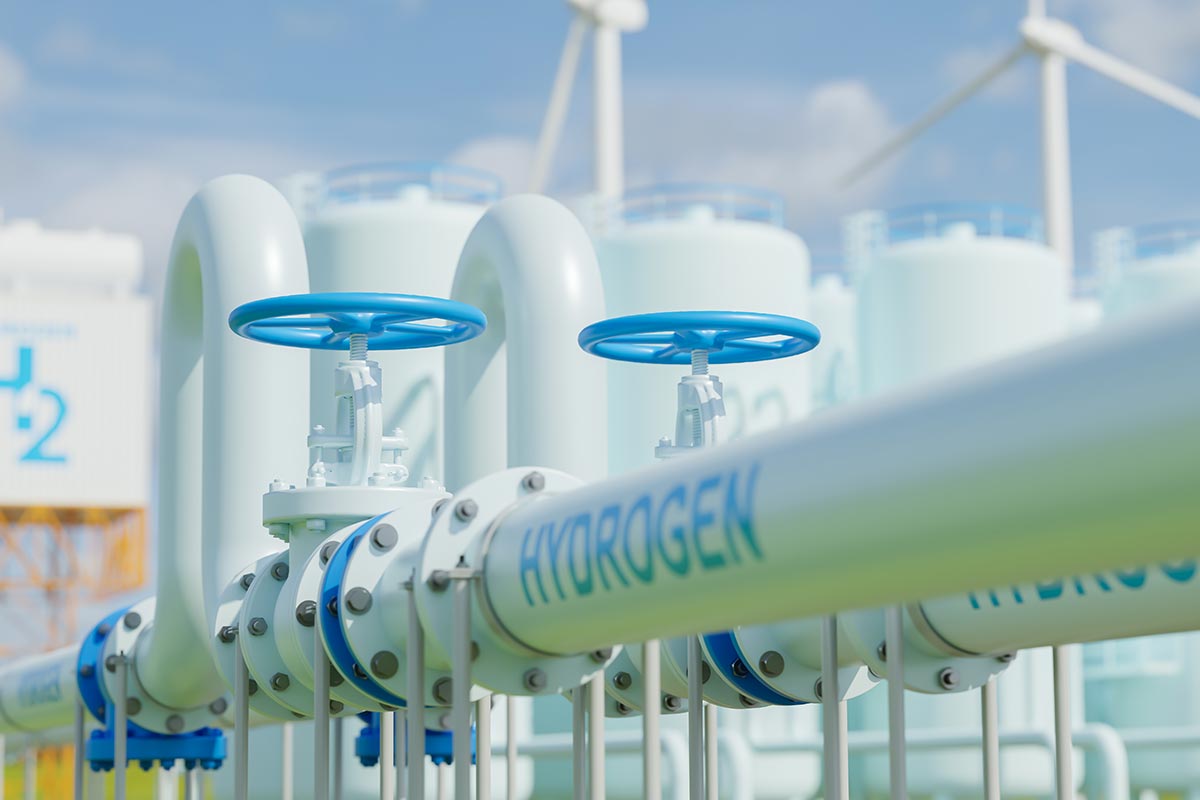
The main noise sources associated with a hydrogen plant will typically include compressors, valves and vents, pumps, cooling fans, flares and piping. Noise mitigation measures will typically include location in buildings, acoustic enclosures, pipe lagging, low noise fans, low noise flares and attenuators.
In many cases, there will also be an associated ammonia plant, incorporating an air separation unit that combines the hydrogen product with nitrogen to form ammonia. The ammonia then provides an easier method of transporting hydrogen, as well as being a useful product in itself (e.g. for fertilizer products). The noise sources associated with the ammonia plant will typically be similar to those associated with the hydrogen plant (e.g. compressors, pumps, vents, flares and piping).
Summary
Industrial hydrogen plants provide a means of utilizing renewable energy in such a way that it can be stored, distributed and used as and when required for a number of purposes, and as such the requirement for new plants in growing.
However, the processes and equipment associated with an industrial hydrogen plant generate environmental noise and it is therefore essential to consider this early on in a project, so that noise control can be allowed for in the design, costs and plant layout.
Spectrum Acoustic Consultants Ltd undertake noise impact assessments for wind farms, solar farms and Hydrogen Plants, as well as for all types of industrial development. For further information on noise and vibration studies please contact us
To view the article above as a downloadable article, including images and charts, please click here

© Spectrum Acoustic Consultants. Registered in England and Wales. Company Number 2378475. Legal Statement. website by topclick