


- Building Acoustics
- Industrial Noise
- Vibration in Buildings
- Vibration in Pipework
- Planning, Permitting & Sustainability
- Pulsation Analysis
- Surge Analysis
- Measurement & Testing
- Services to Consultants
Soundscapes and designing for wellbeing - The new role of acoustics in healthy buildings
14 April 2026 by Elise Phoenix
The conversation around healthy buildings has shifted. For years, the focus sat squarely on air quality, daylight, and thermal comfort.
Acoustics, by comparison, was treated as a compliance issue. Meet the minimum regulatory requirements and applicable acoustic guidance, such as Approved Document E, BB93 or BS 8233, and move on.
That approach is no longer adequate.
A growing body of research now links acoustic environments directly to occupant health, cognitive performance, and long-term wellbeing. Acoustic accessibility for buildings is becoming as important as physical accessibility, as increasingly we realise that poor acoustic conditions can render spaces extremely difficult to use. For architects, developers, and interior designers, this changes the brief and specifications.
PAS 6463 tells us that one of the biggest influences on wellbeing for people with sensory processing differences can be noise. Noise can have a negative physiological and psychological impact.
Acoustic design is no longer about noise control alone. It is about shaping sound environments that actively support the people who use a building.
How sound affects health, productivity, and comfort
Chronic exposure to unwanted noise has measurable effects on the body. Elevated cortisol levels, disrupted sleep, increased cardiovascular risk, and impaired concentration are all well-documented consequences of prolonged noise exposure. In workplaces, the productivity impact is significant. Research from the British Council for Offices and others consistently identifies noise as one of the top complaints among office occupants, ahead of temperature and lighting.
But the issue goes beyond excessive noise levels. Low-frequency rumble from mechanical plant, inconsistent background sound, or overly reverberant spaces can all contribute to fatigue and discomfort, even when measured sound levels technically fall within acceptable limits.
The problem is qualitative as much as quantitative. So a space can comply with noise criteria on paper and still feel uncomfortable to occupy.
This is where the concept of a soundscape becomes relevant. Rather than treating sound purely as something to suppress, soundscape thinking considers the character, variability, and context of what people hear.
A steady hum of distant traffic may be tolerable. Intermittent impact noise from an adjacent space is not, even at a lower decibel level. Designing for wellbeing means understanding these distinctions and responding to them in the initial design brief.
WELL and BREEAM Building Standards and the shift towards indoor environmental quality
The WELL Building Standard, developed by the International WELL Building Institute, as well as BREEAM are bringing acoustics into the mainstream wellbeing conversation.
Unlike the Building Regulations, which focus primarily on sound insulation between residential dwellings, and acoustic conditions in schools, WELL and BREEAM take a broader view. They address background noise levels, reverberation times, sound masking, and acoustic privacy, applying them across different space types including offices, healthcare facilities, education buildings, and residential developments.
For developers targeting high-performance certifications, acoustic design has become a core requirement rather than a secondary consideration.
What these frameworks share is a focus on the occupant experience. They move the conversation from minimum compliance towards optimal conditions, asking not just whether a building meets a noise threshold but whether it creates an environment in which people can work, rest, learn, or recover effectively.
Designing with natural soundscapes and low-reverberation spaces
One of the more practical shifts in acoustic design thinking involves the deliberate use of natural or positive sound sources to improve occupant experience.
External courtyards with water features, planting that encourages birdsong, or carefully placed openings that allow controlled natural sound into a building can all contribute to a more restorative acoustic environment.
This is not about replacing acoustic engineering with landscaping. It is about recognising that the absence of unwanted noise does not automatically create a comfortable space. Overly quiet environments can feel oppressive and increase sensitivity to minor sounds, a common complaint in highly insulated modern buildings. Introducing appropriate ambient sound, whether natural or through sound masking systems, can improve perceived comfort and speech privacy.
Internally, reverberation control remains a priority, particularly in open-plan offices, education spaces, and healthcare environments. Excessive reverberation reduces speech intelligibility, increases vocal effort, and contributes to listener fatigue.
Material selection, ceiling treatment, and the geometry of a space all influence reverberation. Absorptive finishes on ceilings and upper walls, combined with diffusing elements at mid-height, can reduce reverberation without making a space feel acoustically dead. The balance matters and the goal is controlled, comfortable sound, not silence.
Material choices and layout design for wellness
Acoustic performance is influenced as much by the spatial layout of a building as by the materials used within it.
Buffer zones between noisy and sensitive spaces, careful zoning of mechanical plant, and the strategic placement of circulation routes can all reduce the need for heavy acoustic intervention later in the design process.
At the material level, the range of sustainable absorptive and insulating products available to designers has expanded considerably. Perforated timber panels, recycled polyester acoustic panels, open-cell ceiling tiles, and fabric-wrapped absorbers all offer different combinations of acoustic performance, aesthetic quality, and sustainability credentials.
The choice should be driven by the specific acoustic requirement of the space, not by habit or cost alone.
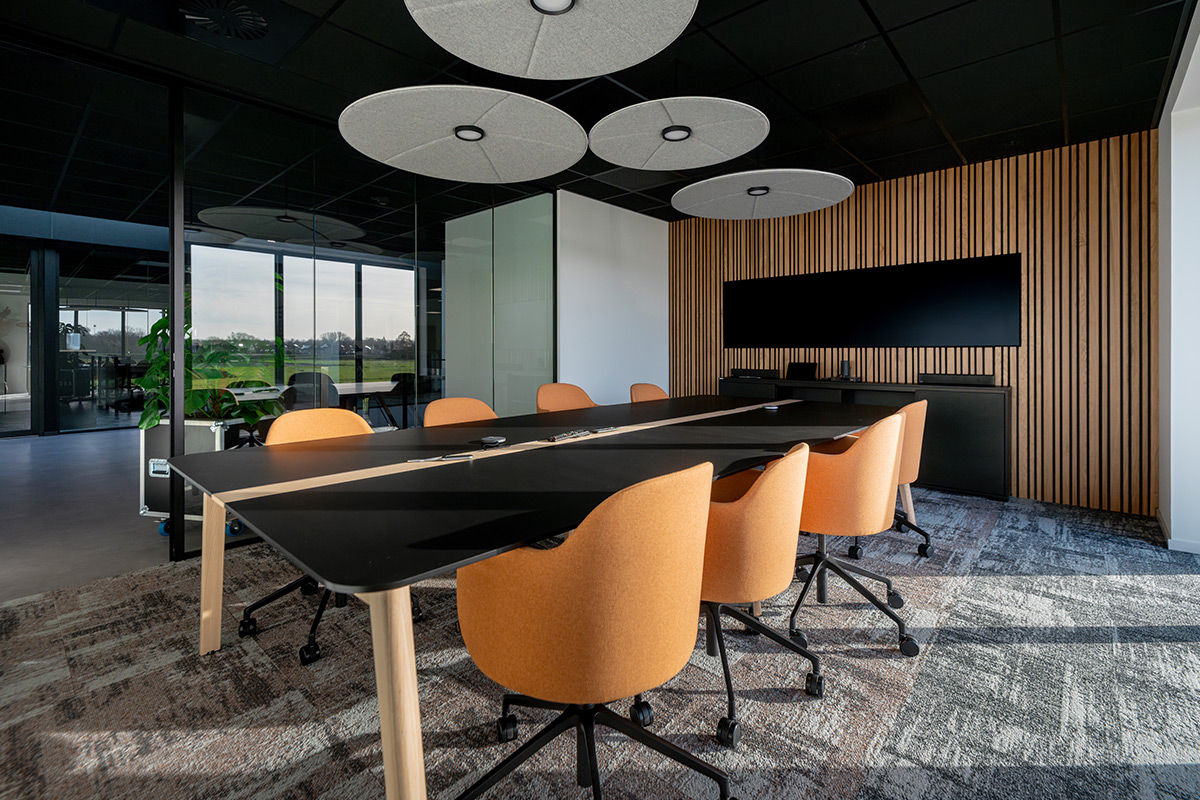
For interior designers in particular, the integration of acoustic performance into the design language of a space is now expected. Acoustic solutions that were once hidden above suspended ceilings are increasingly visible, forming part of the interior character. This creates an opportunity to treat acoustic design as a design feature rather than a technical afterthought.
Layout decisions made at RIBA Stages 2 and 3 have a disproportionate effect on the final acoustic outcome. Relocating a plant room or introducing a lobby between a reception area and an open-plan workspace can deliver more acoustic benefit than any amount of post-completion treatment.
Early collaboration between architects, acoustic consultants, and interior designers is the most effective way to embed acoustic wellbeing into a project.
Nick Treby, Director at Spectrum Acoustic Consultants, comments,
“The most effective wellbeing outcomes come from getting acoustics into the conversation early, alongside the architect and interior designer, not after the layout is fixed.
When we work with design teams from the outset, we can shape spaces that genuinely support how people feel and perform, rather than retrofitting solutions that compromise the original design intent and add cost. That collaborative approach is central to everything we do at Spectrum.”
Working with Spectrum Acoustic Consultants
Spectrum Acoustic Consultants has over 35 years of experience in building acoustics, working with architects, developers, and design teams across residential, commercial, healthcare, education, and mixed-use projects.
Our approach is collaborative and technically rigorous, integrating acoustic design into the wider project strategy from the earliest stages.
The Palace (Prince of Wales) Cinema in Kentish Town is a good example of this in practice. Spectrum was appointed from RIBA Stage 3 to support the planning application and shape the acoustic strategy for London Borough of Camden’s regeneration of the 1913 heritage cinema into a flexible Neighbourhood Space.
The building’s proposed mix of meeting rooms, collaboration zones, workspaces, and an event area created competing acoustic requirements within a structure never designed for multiple uses. Spectrum worked closely with architects IF_DO and the wider design team to define realistic performance targets for speech privacy, background noise control, and room acoustics, balancing these against the need to retain the building’s heritage character and minimise unnecessary construction.
Critically, acoustic wellbeing was considered at the design stage rather than retrofitted later. Reverberation control in the large-volume former cinema space, mechanical plant noise assessment in accordance with BS 4142:2014+A1:2019, and internal sound separation between quiet and active zones were all integrated into the design as it developed. The result is an acoustic strategy that supports occupant comfort and usability without compromising Camden’s sustainability objectives or the building’s original character.
Read the full project here
Whether you are designing to WELL, BREEAM, or simply aiming to deliver a better acoustic environment for occupants, our team can help you achieve it.
Contact our team by telephone 01767 318871, by email or alternatively fill out our contact form and we will contact you as soon as we can.

© Spectrum Acoustic Consultants. Registered in England and Wales. Company Number 2378475. Legal Statement. website by topclick